Medical Billing | Revenue Cycle Management | Denial Prevention
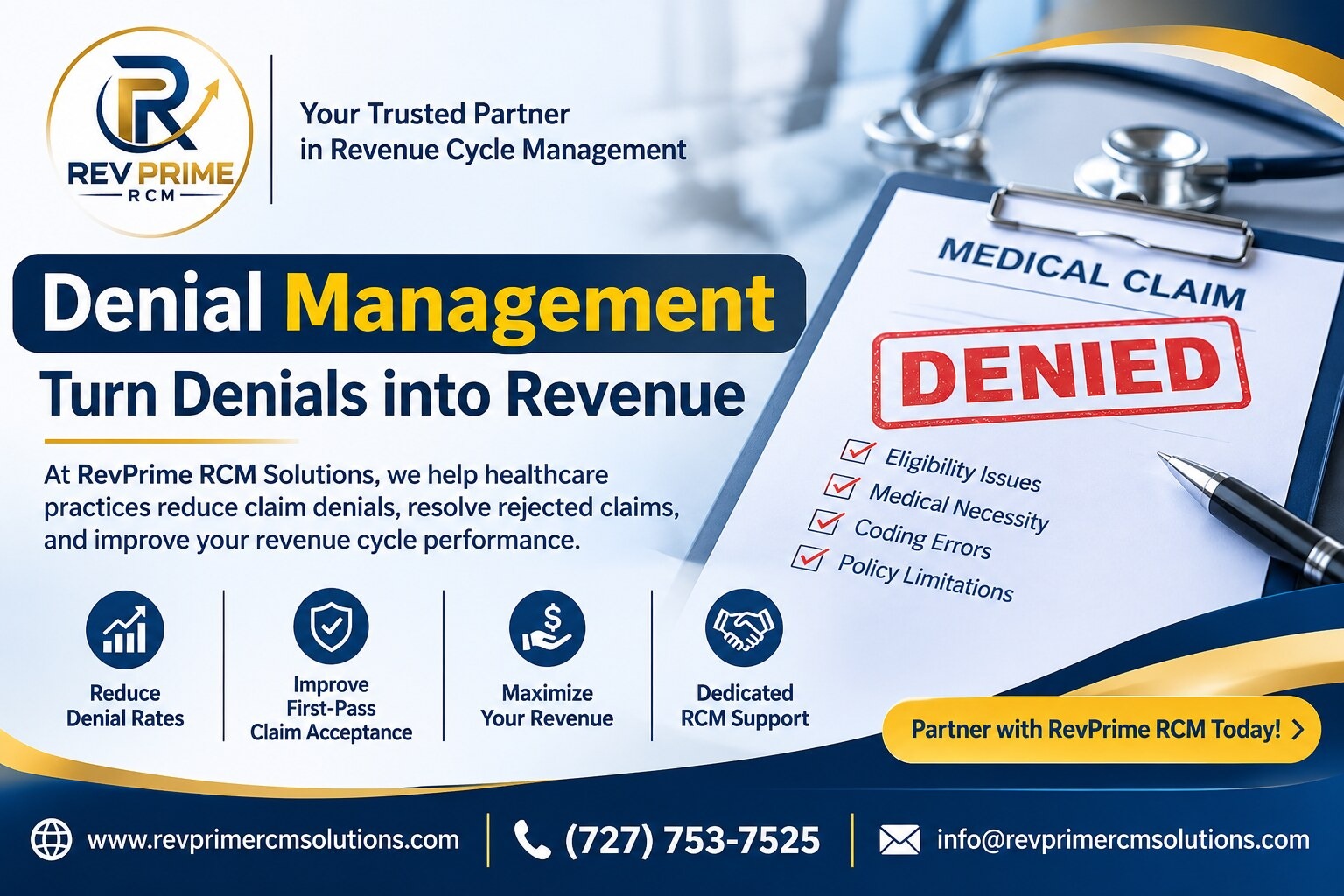
Medical claim denials are one of the biggest challenges healthcare practices face when managing their revenue cycle. Even after providing services to patients, medical practices may experience delayed payments or lost revenue because of incorrect claim information, coding errors, missing documentation, authorization issues, or insurance coverage discrepancies.
An effective medical billing denial management process helps healthcare providers identify claim issues, correct billing errors, follow up with insurance companies, and prevent recurring denials.
At RevPrime RCM Solutions LLC, we understand the importance of organized claims management, accurate medical billing, and consistent insurance follow-up in maintaining a healthier revenue cycle.
What Is Denial Management in Medical Billing?
Denial management in medical billing is the process of identifying, reviewing, correcting, appealing, and tracking insurance claims that have been denied by payers.
When an insurance company denies a claim, the billing team must determine the reason for the denial and identify the appropriate next step. Depending on the payer’s explanation and applicable rules, this may involve submitting a corrected claim, providing additional documentation, or filing an appeal.
A structured denial management strategy helps practices reduce administrative delays, protect earned revenue, and improve the overall medical billing workflow.
Common Reasons for Medical Claim Denials
Understanding why insurance companies deny medical claims is the first step toward preventing avoidable billing problems.
Here are some common reasons for claim denials:
1. Incorrect Patient or Insurance Information
Incorrect patient demographics, policy numbers, subscriber details, or insurance information can result in rejected or denied claims.
Solution: Verify patient demographics and insurance information before submitting claims.
2. Missing Prior Authorization
Some medical services and procedures require prior authorization from the insurance company. Claims may be denied when required authorization is missing, invalid, or does not cover the service provided.
Solution: Maintain an organized authorization tracking process and confirm payer requirements before services are performed.
3. Medical Coding Errors
Incorrect CPT, ICD-10-CM, or HCPCS codes, missing modifiers, and coding inconsistencies can affect claim processing and reimbursement.
Solution: Review coding accuracy and ensure that submitted codes are supported by the medical documentation and applicable payer guidelines.
4. Timely Filing Limitations
Insurance companies establish filing deadlines for claim submission. Claims submitted after the applicable deadline may be denied.
Solution: Monitor claim submission timelines and maintain a consistent billing workflow to avoid unnecessary filing delays.
5. Medical Necessity Issues
Payers may deny claims when the submitted documentation does not sufficiently support the medical necessity of the billed service under the applicable coverage policy.
Solution: Review payer policies and ensure that clinical documentation supports the services billed.
6. Coordination of Benefits (COB) Errors
When patients have multiple insurance policies, incorrect primary and secondary payer information can create claim processing problems.
Solution: Confirm insurance order and coordination of benefits before submitting claims.
6 Effective Strategies to Reduce Medical Billing Claim Denials
Preventing denials requires a consistent approach throughout the revenue cycle.
1. Perform Insurance Eligibility Verification
Verify active insurance coverage, copayments, deductibles, coinsurance, and available benefits before appointments.
2. Review Claims Before Submission
Check patient demographics, insurance details, diagnosis codes, procedure codes, modifiers, and required documentation.
3. Track Prior Authorizations
Maintain authorization records and monitor approval status, expiration dates, and authorized service limits.
4. Monitor Claim Status Regularly
Follow up on pending claims and investigate unpaid or rejected claims before they become significantly delayed.
5. Analyze Denial Trends
Track denial reasons and identify recurring issues by payer, service, provider, or workflow.
6. Submit Corrected Claims and Appeals Promptly
Review each denial carefully, follow the payer’s instructions, and submit corrections or appeals within the applicable deadlines.
Why Is an Effective Denial Management Process Important?
A well-organized denial management process supports healthcare practices in several ways:
- Improved Revenue Collection: Helps recover eligible reimbursement for services already provided.
- Reduced Administrative Work: Identifies recurring problems and reduces unnecessary rework.
- Better Claim Accuracy: Encourages consistent claim reviews and billing procedures.
- Improved Cash Flow: Supports timely claim resolution and payment follow-up.
- Stronger Revenue Cycle Performance: Provides better visibility into billing issues and outstanding claims.
How RevPrime RCM Solutions Supports Medical Practices
Managing insurance claims, denials, and outstanding balances can consume valuable time and administrative resources.
RevPrime RCM Solutions LLC provides medical billing and revenue cycle management support designed to help healthcare practices maintain organized billing operations.
Our services include:
- Medical Billing and Claims Submission
- Insurance Eligibility and Benefits Verification
- Prior Authorization Support
- Medical Coding Support
- Denial Management and Claims Follow-Up
- Accounts Receivable (A/R) Management
- Payment Posting and ERA Processing
- Credentialing and Provider Enrollment
Our goal is to support healthcare providers with structured revenue cycle workflows so they can spend more time focusing on patient care.
Final Thoughts
Medical billing claim denials should not be treated as isolated billing problems. Identifying the root cause, correcting errors, following up with insurance companies, and monitoring recurring denial patterns are essential steps toward improving revenue cycle performance.
Whether you operate an independent medical practice, specialty clinic, or group practice, an organized denial management strategy can help strengthen your billing operations.
Looking for reliable medical billing and denial management support?
Partner with RevPrime RCM Solutions LLC to discuss your practice’s billing needs.
Contact RevPrime RCM Solutions LLC
Website: https://www.revprimercmsolutions.com/
Email: info@revprimercmsolutions.com
Phone: 727-753-7525
Your Practice Deserves More Than Just Billing.
Information for general education only. Specific payer rules and reimbursement requirements should be verified for each applicable setting.